
Introduction
IFRS (International Financial Reporting Standards) 9 is an accounting standard developed between 2008 and 2014. On 1 January 2018, IFRS 9 was incorporated into EU law under Regulation (EC) No 1126/2008, which was later replaced by Regulation (EU) 2023/1803. Chapter 5 of the standard requires an entity to have a system to measure credit risk and to set aside capital to mitigate the effects of credit losses. The standard was developed in response to IAS 39 and similar standards which, during the financial crisis of 2008, did not increase the level of provisions until after default, which proved insufficient to mitigate these effects. IFRS 9 aims to make loss allowances more effective by including forward-looking information and by increasing the allowance ratio when there is an indication of a significant increase of credit risk (SICR). Changes in the present value of future cash flows affect the valuation of an asset recognised under IFRS 9 and the calculation of expected credit losses under IFRS 9 is based on this.
Expected Credit Loss (ECL)
The capital set aside is calculated on the basis of expected credit losses (ECL), which IFRS 9 requires to be done using probability models for loss scenarios. This means that the expected losses should be calculated separately for several scenarios with different assumptions based on forward looking information (FLI), with the outcomes weighted based on the probability of the scenarios. In EBA/Rep/2023/36, the most common scenarios are described as base/up/down. The FLI most commonly used are GDP forecasts, unemployment forecasts and interest rate forecasts, such as EURIBOR. These usually extend over periods of between 2-5 years. The purpose of calculating separate scenarios is mainly to capture non-linear effects on the ECL arising from the different assumptions. This differs from the estimation of expected credit losses in the United States, which is based on the Financial Accounting Standards Board (FASB) standard for Current Expected Credit Loss (CECL), where it is allowed to use only one forward-looking scenario.
Article B5.5.12 of IFRS 9 exemplifies two methods for the calculation of ECL, PDxLGD models and credit loss ratio models. PDxLGD models use probability of default (PD) and loss given default (LGD) to calculate ECL. Loan loss ratio models compare historical losses with historical exposure for groups of loans or customers. For example, corporate loans with a certain credit rating can be grouped. Then the historical losses of the group are calculated as a proportion of the group's historical exposures as a credit loss ratio, which is then multiplied by the group's current exposures to give the group's current ECL. EBA/Rep/2021/35 PL (Probability of Loss) x LGL (Loss Given Loss) models are also mentioned but it is clarified that PDxLGD models are by far the most common type of model in the EU. In an IFRS 9 model, the loan loss allowance is recalculated at each reporting date. The main tool used to reduce or increase the allowance for an individual exposure is to vary the time period for which losses are provided. Where a credit has low or non-extended credit risk (Stage 1), the expected losses are used for the next 12 months, while in the case of SICR (Stage 2) and non-performing credits (Stage 3), the expected losses are used for the entire life of the credit.
Significant Increase in Credit Risk (SICR)
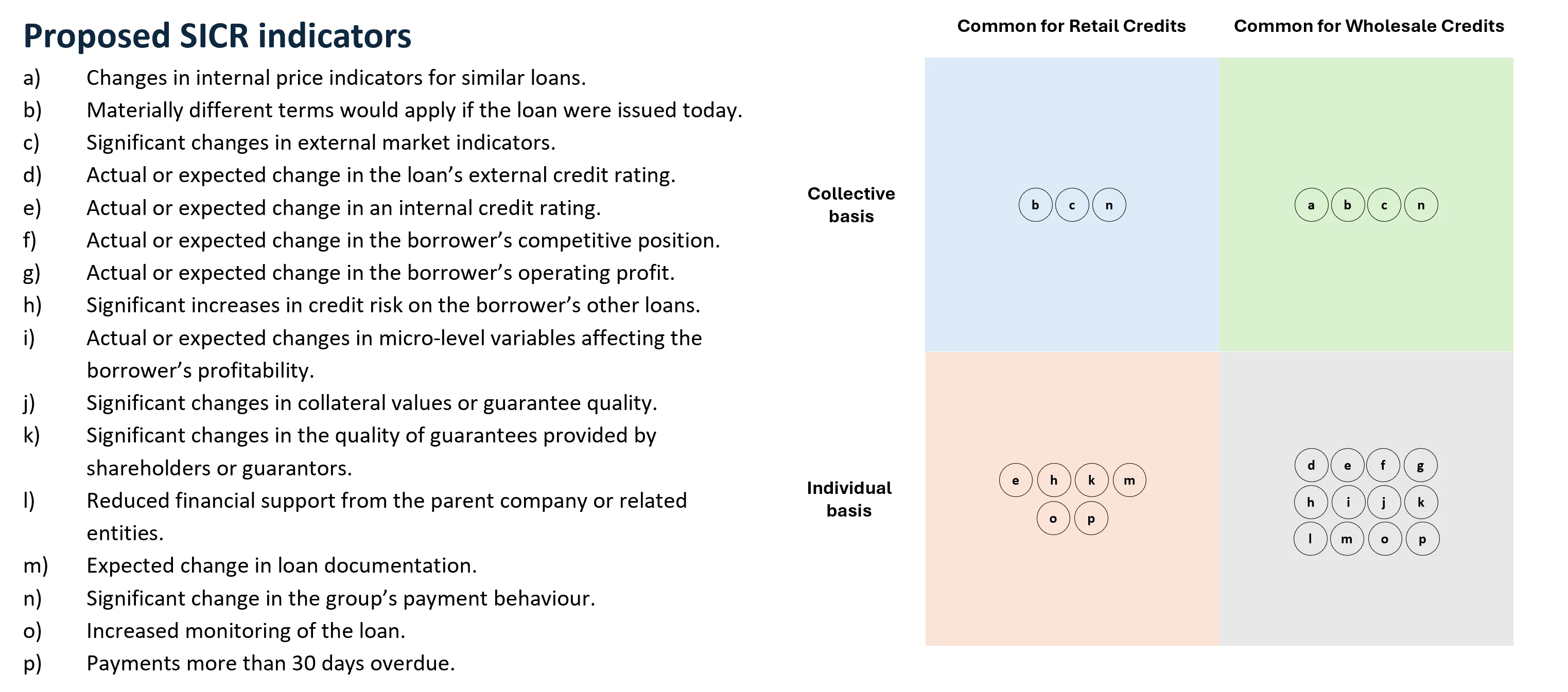
Where readily available and reliable information is available to indicate the SICR, it shall be used. In the first instance, factors on an individual instrument basis should be considered, but if an institution does not have information available on an individual basis, the assessment of SICR should be made on a collective basis. The standard does not specify which indicators of SICR should be used, except for a rebuttable presumption that it is indicated by contractual payments being more than 30 days late. According to EBA/GL/2017/06, the 30-day criterion should not be used as a primary indicator of the SICR, but it is not excluded as a backstop to complement other forward-looking indicators. EBA report, as of December 2018, only 19% of the banks surveyed reported using the 30-day criterion as a backstop. Article B5.5.17 of IFRS 9 also proposes 16 additional indicators for SICR. EBA/Rep/2023/36, cites applications for credit relief measures, as well as whether the customer is on a watch list, as the most common ways in which qualitative information is included in the assessment of the SICR. The Global Public Policy Committee (GPPC) suggests in its guide for the implementation of IFRS 9 that it may be appropriate to apply a probationary period for certain qualitative indicators, such as for forbearance and delays.
Default
The standard lacks clear requirements on the definition of default, apart from a rebuttable presumption that it occurs no later than when contractual cash flows become 90 days past due. EBA report, as of December 2018, only 26% of the banks surveyed reported using the 90-day criterion as a backstop. Article B5.5.37 of IFRS 9 also requires default definitions to be consistent with other internal credit risk management and to take into account qualitative indicators such as loan covenants where default is defined. As a result, the standard interacts with other applicable credit risk frameworks, such as the CRR (Regulation (EU) 575/2013For credit institutions applying the CRR, the guidelines on definitions of default published by the EBA will be applicable to IFRS 9. In both EBA/Rep/2021/35 and EBA/Rep/2023/36, it appears that it is common for institutions to equate the concepts of Stage 3, default and NPL. For example, the criteria for unlikelihood of payment described in EBA/GL/2016/07 be included in the default definition of the IFRS 9 model, as recommended in the Basel guidelines on ECL for banks applying IFRS.
Special Rules and Capital Effects
In addition to the general rules for provisions under IFRS 9, there are also rules for special cases. When it comes to calculating the allowance for credit losses for assets that have been issued or purchased with deteriorating credit risk, they are compared to the credit risk with which they were originally issued. For example, purchased non-performing loans will then be reserved with lifetime losses until their risk is considered low or not elevated compared to the credit agreement entered into with the original credit issuer. IFRS 9 allows the simplified approaches described in IFRS 15 and IFRS 16 to be used for calculating the allowance for credit losses for trade receivables, contract assets and lease receivables.
The credit loss allowance is recognised as accumulated losses and therefore reduces the accumulated profits included in CET1. As IFRS 9 provides a significantly larger allowance than IAS 39, without transitional provisions this would result in a large initial reduction of own funds. Therefore, under Article 473a of the CRR, part of the IFRS 9 loss allowance has been permitted to be included in CET1 during a transitional period (2018–2024). In response to Covid-19, the proportion was increased to 25% during 2022–2024. However, after 31 December 2024, the transitional period expired and the full amount is now deducted from CET1.
Support with IFRS 9
Read more about our services in risk modelling and model validation or contact us if you have any questions about the management of IFRS 9 or its interactions with other credit risk frameworks.