
Introduction
When the new regulations on interest rate risk in the bank book (the ”IRRBB”) came into effect, higher requirements were placed on credit institutions” interest rate risk models. The firm NFC was tasked with helping a Swedish niche bank update existing models for both economic value of own funds (”EVE”) and interest rate net income (”NII”) to ensure full regulatory compliance and reliability in the calculations.
In conjunction with the implementation of the new requirements, the bank had a stated ambition to streamline processes by reducing manual processing in calculations and reporting. Therefore, it NFC was tasked with developing, implementing, and documenting the updated models throughout the entire process until they were put into operation.

Background
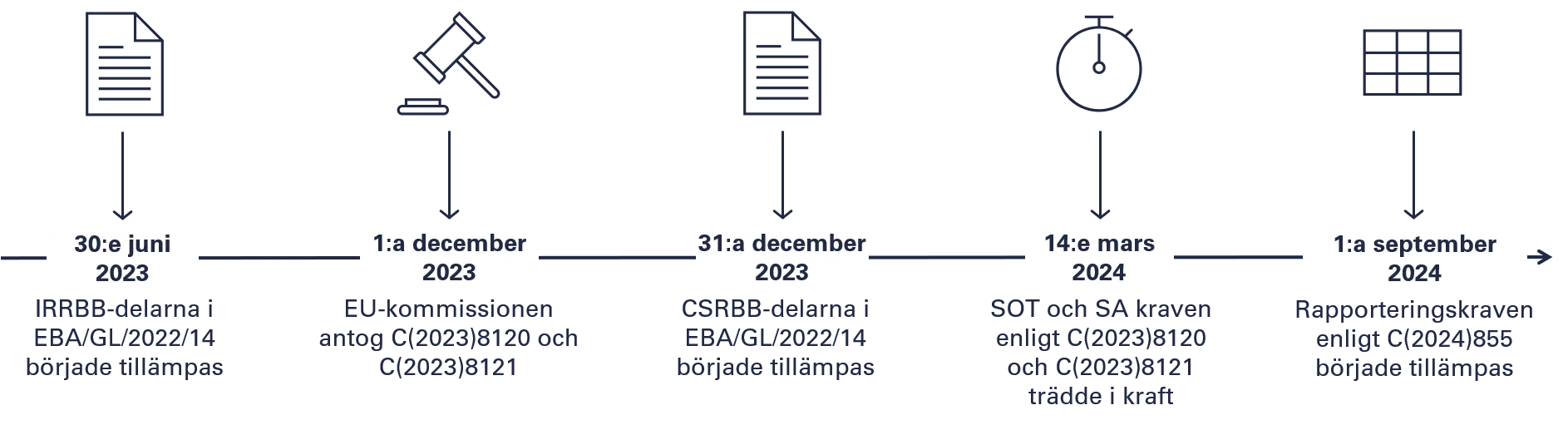
The revision of CRD IV in 2019 This meant a changed mandate for the European Banking Authority (EBA) regarding the IRRBB. As a result, the EBA published a updated regulatory package for IRRBB, with the corresponding Guidelines and technical standards, which would gradually begin to be applied in 2023 and 2024. The new standards meant that Supervisory Outlier Test (SOT) utökades till att även omfatta NII, and that new template methods and reporting templates was introduced.
For the bank, the regulations brought increased modeling requirements and a greater need for model documentation. The regulatory updates increased both the scope and complexity of the bank’s work with the IRRBB, while there was uncertainty about which parts of the regulatory package were applicable based on the bank’s size, operations, and risk profile. This created the need for new calculation methods, increased data collection, and more comprehensive reporting, which placed higher demands on the bank’s models, systems, and governance framework.
Execution
In light of these new requirements, consultants were hired NFC to develop the bank’s IRRBB framework. Initially, the NFC bank’s existing models and processes were mapped out, and a gap analysis was conducted that identified areas that needed to be adapted to meet the new regulatory requirements. Based on the gap analysis, proposals were developed on which parts of existing models could be reused and which deficiencies needed to be addressed.
Based on the gap analysis, NFC new calculation models for IRRBB were developed that included both EVE and NII. In consultation with the bank, the standard method for IRRBB was implemented. The models were developed in Excel with automated functionality built into VBA, so that EBA’s reporting templates are filled in automatically, simplifying the reporting process. In parallel, the bank’s IRRBB framework was adapted, and corresponding model documentation was created to ensure traceability and reproducibility.

Outcome
The result of NFC s work meant that the bank obtained a correct and efficient model for calculating EVE and NII, adapted to the new regulations. The associated model documentation contributes to increased transparency and traceability in the model framework, as well as facilitating future review and development. The automated and simplified process for calculating the IRRBB and filling in the EBA reporting templates saves time in reporting and reduces the risk of manual errors, freeing up resources for analysis.
By adapting the model to the bank’s needs, applying the standard method and calculating the SOT, full compliance with regulations and good risk management were ensured. This also reduced the risk of penalties from the Financial Supervisory Authority, strengthening the bank’s regulatory position.
The new model for EVE, which NFC helped the bank implement adjustments to exclude commercial margins in accordance with the bank’s internal risk management, has been adapted. As a result, the SOT outcome has become lower and more representative. The change strengthens the model’s risk-related relevance and increases the transparency in the bank’s IRRBB reporting.
The project shows how NFC to combine expertise in IRRBB, process automation, and regulatory interpretation to create effective solutions that meet all regulatory requirements. Is this relevant to your business? Read more about our risk modelling and model validation services or contact us directly and we’ll tell you more!


