
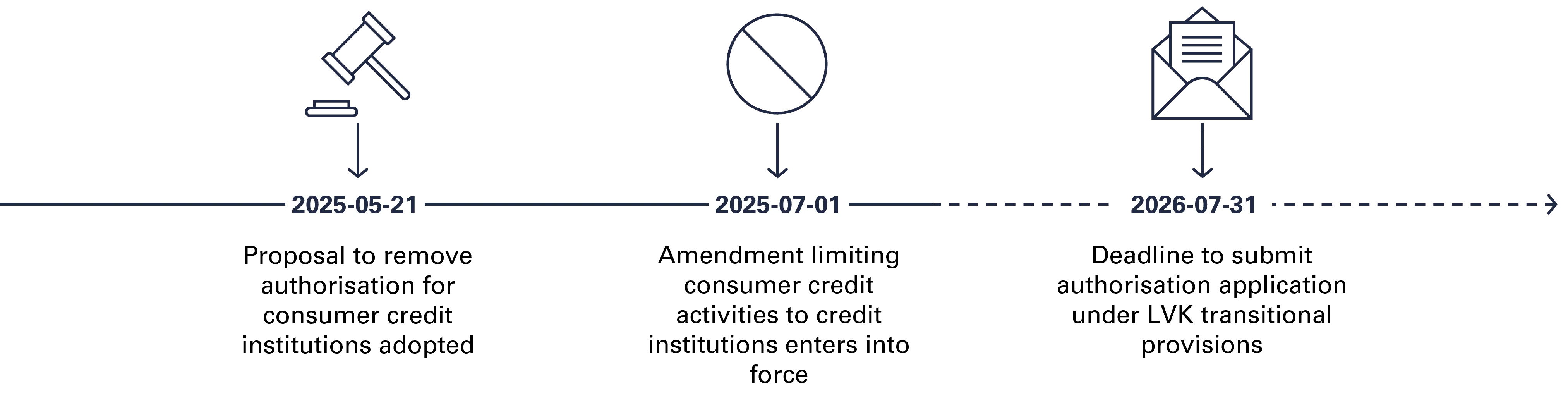
Following Parliament’s adoption of government proposal 2024/25:138 the regulatory framework for authorisations required to grant and mediate consumer credit was amended. The main changes are that the Act (2014:275) on certain consumer credit activities (LVK) will be repealed with effect from 1 July 2025, and that the Act (2004:297) on banking and financing business (LBF) has been supplemented with Chapter 1, Section 7a. These changes mean that only companies authorised to conduct banking or financial business (credit institutions) may grant and mediate consumer credit. However, the LBF includes explicit exemptions for companies that, under other authorisations, carry out activities that allow them to issue or mediate consumer credit, for example mortgages or credit cards. An additional exemption applies to firms that, before 1 July 2025, were authorised or exempted from authorisation under the LVK (consumer credit institutions).
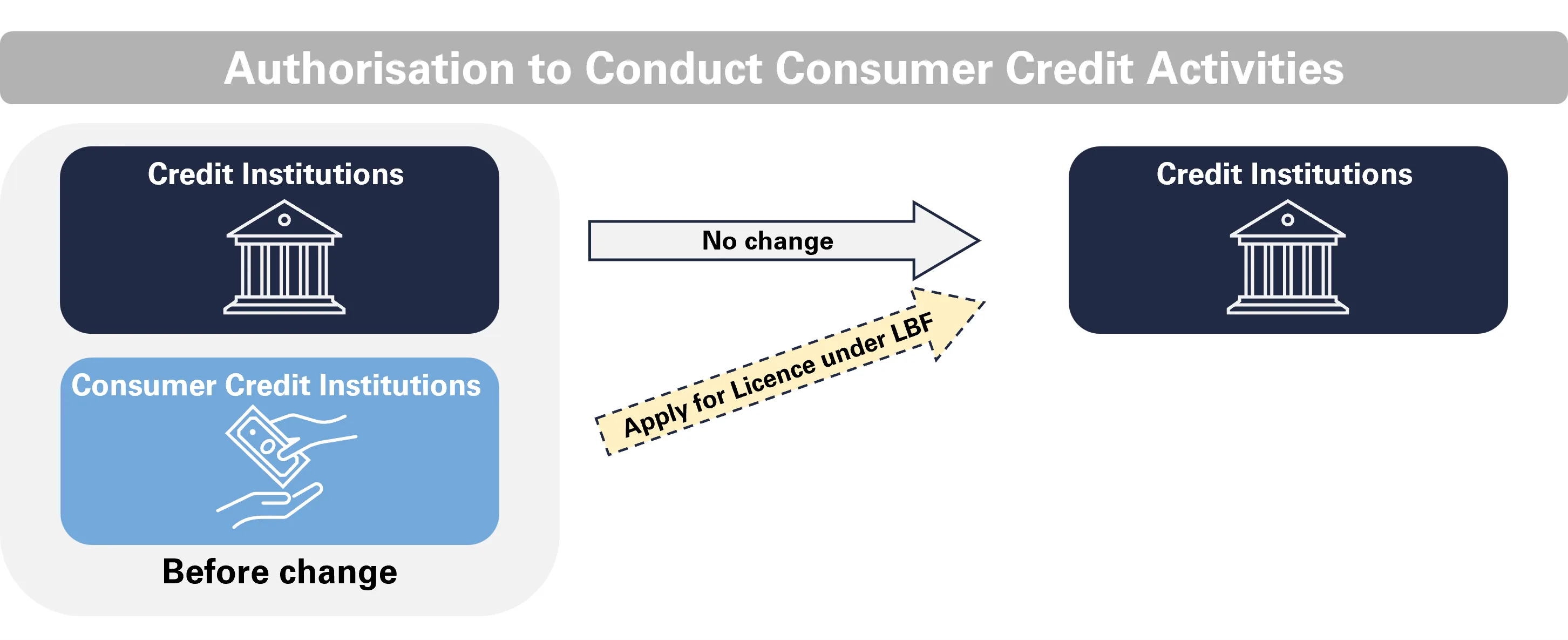
According to the transitional provisions of LVK, consumer credit institutions may continue operating until 31 July 2026. If such a company submits an application for authorisation to conduct banking and financing business by 31 July 2026, it may continue operating under LVK until the application has been finally assessed.
Consumer credit institutions that intend to continue operating face a significant challenge due to the requirement to be authorised as a credit institution. The regulatory framework for banking and financing activities is considerably more extensive and complex than the requirements that apply to operations providing or mediating consumer credit under LVK. It is therefore crucial to ensure that the business has the necessary prerequisites to meet these higher requirements even before the application process begins.
For guidance on the information to be provided when applying for authorisation to conduct banking or financial business, the Swedish Financial Supervisory Authority (FI) refers to (EU) 2022/2580. The information to be submitted is extensive, and the regulatory framework provides no relief for businesses that were previously operating as consumer credit institutions. In summary, an application must include, among other things, the following:
- Detailed business plan for at least the first three years after authorisation.
- The institution's financial information, including projected cash flows, balance sheets and income statements for at least 3 years, together with the associated assumptions for both base and stress scenarios.
- A description of the institution's capital situation and an assessment of the internal capital requirements for the next three years.
- Information on management, ownership and organisational structure.
- Basis for ownership and management assessment.
- Policy document packages that fulfil the applicable requirements.
- Documentation demonstrating that, and how, the initial capital requirement of EUR 1–5 million has been, or will be, met.
NFC believes that the transition from consumer credit institution to credit institution entails significantly increased regulatory and organisational requirements. For organisations that are affected by the legislative changes described above, NFC can assist and contribute to a smoother transition. With long and solid experience of licensing cases and credit institutions, we offer support throughout the process - from preparing the application and handling supplementary requests to preparing for and supporting after the licence has been granted. If you have already started the work, we can carry out a second opinion and quality assure existing material produced to reduce the risk of deficiencies and streamline the dialogue with the authority. Read more about our licence application services or contact us if you have any questions or would like support with the transition to a credit institution.