
Greater Transparency and a More Sustainable Economy
Corporate Sustainability Reporting Directive (CSRD) is an EU directive that aims to improve and standardise corporate sustainability reporting. By replacing and extending the previous the non-financial reporting directive (NFRD), the CSRD sets higher requirements for companies to report on their environmental, social and governance (ESG) impacts. It now covers more companies, including small and medium-sized listed companies, and requires sustainability data to be verified by an independent third party. CSRD is part of the EU's Green Deal (Green Deal) and aims to increase transparency and drive the transition to a more sustainable economy within the Union.
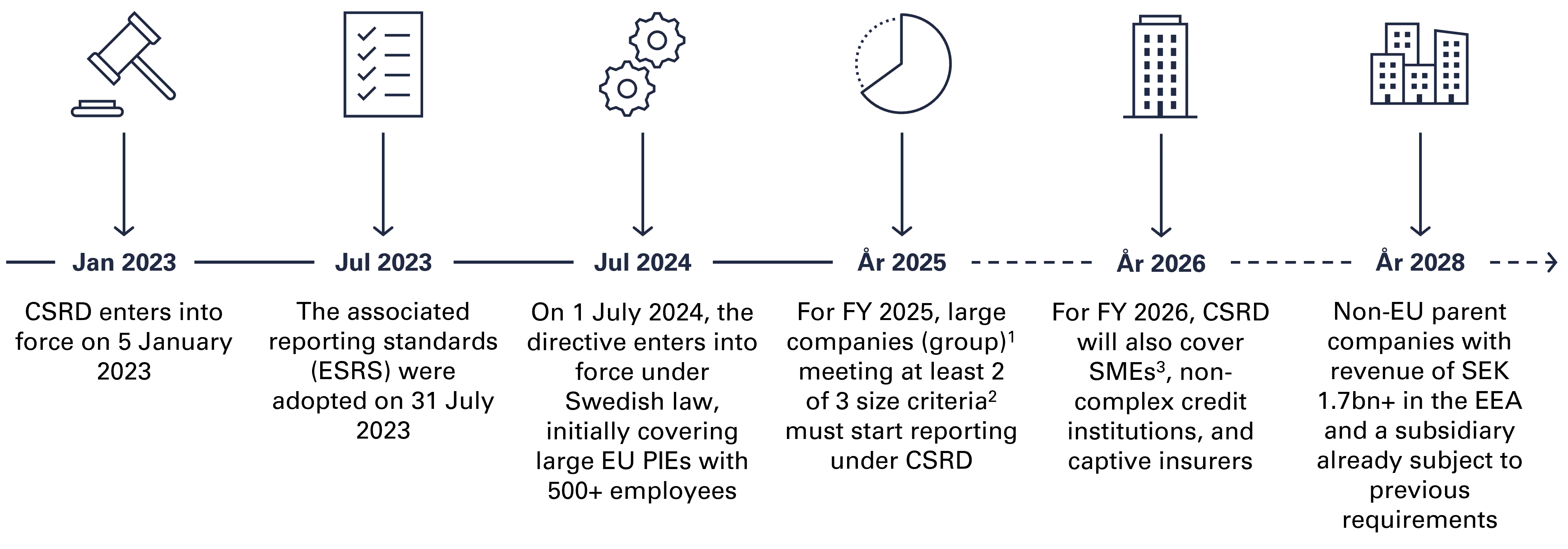
1) Includes large EU Public Interest Entities with 500+ employees in any of the last two financial years, 2) If the company has had 250+ employees, 550+ MSEK in net sales or 280+ MSEK in total assets in any of the last two financial years, 3) SME is classified as a company with net sales > 10 MSEK, total assets > 5 MSEK, and number of employees > 10
How CSRD Affects Businesses in Practice
- Companies must comply with mandatory EU standards for sustainability reporting.
- Companies are required to disclose sustainability information related to their business models, strategies and supply chains.
- Sustainability reporting shall be integrated into the management report and reviewed by an auditor or other external party.
- Financial statements and the management report must be in digital XHTML format, with sustainability data labelled according to an established digital taxonomy.
A key concept in CSRD is the ”dual materiality perspective”, which means that there are two perspectives from which a sustainability issue is material, ”consequential materiality” and ”financial materiality”. A sustainability issue is material from a consequential perspective when it relates to the company's significant, actual or potential positive or negative impacts on people or the environment in the short, medium and long term. A sustainability issue is material from a financial perspective if it involves risks or opportunities that affect the financial position, performance, cash flows, access to finance or cost of capital of the entity in the short, medium or long term.
Materiality Analysis
The materiality analysis should be carried out for the company's own operations as well as upstream or downstream in its value chain, including through its products and services, and through business relationships. This means that, for example, a bank must identify whether its loans have financed activities that have an impact on a sustainability issue and, if so, whether this impact is material. Extensive work to fulfil the requirements of the CSRD awaits both financial and non-financial companies in the coming years. Companies that will be reporting for the 2025 financial year should therefore already identify the sustainability issues that are material to their business and then establish processes to collect the data required for reporting.
Sustainability Issues in Financial Firms’ Operations
Below, we have highlighted some of the sustainability issues that we at NFC see as the most relevant to companies' own operations for companies in the financial sector:
- Labour conditions
- Working hours
- Fair wages
- Equal treatment and opportunities for all
- Gender equality and equal pay for work of equal value
- Training and skills development
- Diversity
- Information-related impacts on consumers
- Personal integrity
- Access to goods and services
- Responsible business behaviour
- Corporate culture
- Protection for whistleblowers
- Corruption and bribery
In accordance with the CSRD, the materiality analysis should also take into account impacts that may arise from financing. With this in mind, we at NFC recognise that financial companies whose activities largely consist of corporate and project finance will have a lot of work ahead of them to identify the materiality of their financing.
Sustainability Issues in Financed Companies’ Operations
Some of the sustainability issues we see that may be time-consuming to identify in the funded companies' operations are:
- Pollution
- Pollution of air, water, soil
- Water and marine resources
- Water consumption
- Extraction and utilisation of marine resources
- Biodiversity and ecosystems
- Pollution
- Direct exploitation
- Land degradation
- Workers in the value chain
- Child labour
- Forced labour
- Water and sanitation
- Gender equality and equal pay for work of equal value
Next Steps
To effectively meet the CSRD reporting requirements, we recommend reviewing how your organisation identifies and collects sustainability information and how it manages environmental, social and governance risks. At NFC, we can support you on how CSRD affects your business and what changes you need to make to fulfil the new requirements. Read more about our regulatory reporting services or contact us below to find out more!