
🏦 Introduction
The implementation of the EU's new anti-money laundering package will bring about significant changes for financial institutions and other obliged entities. To harmonise supervision across the Union, the reporting templates are now being revised for both the annual reporting to the Swedish Financial Supervisory Authority (Finansinspektionen) and the reporting of suspected money laundering and terrorist financing to the Swedish Financial Intelligence Unit (Finanspolisen). The new and more detailed data requirements mean that affected organisations will need to review and adapt their reporting solutions. For annual reporting, the new requirements will already apply as of the reference date of 31 December 2026, while new formats for suspicious transaction reporting will be phased in at a later stage.
📅 Annual Reporting
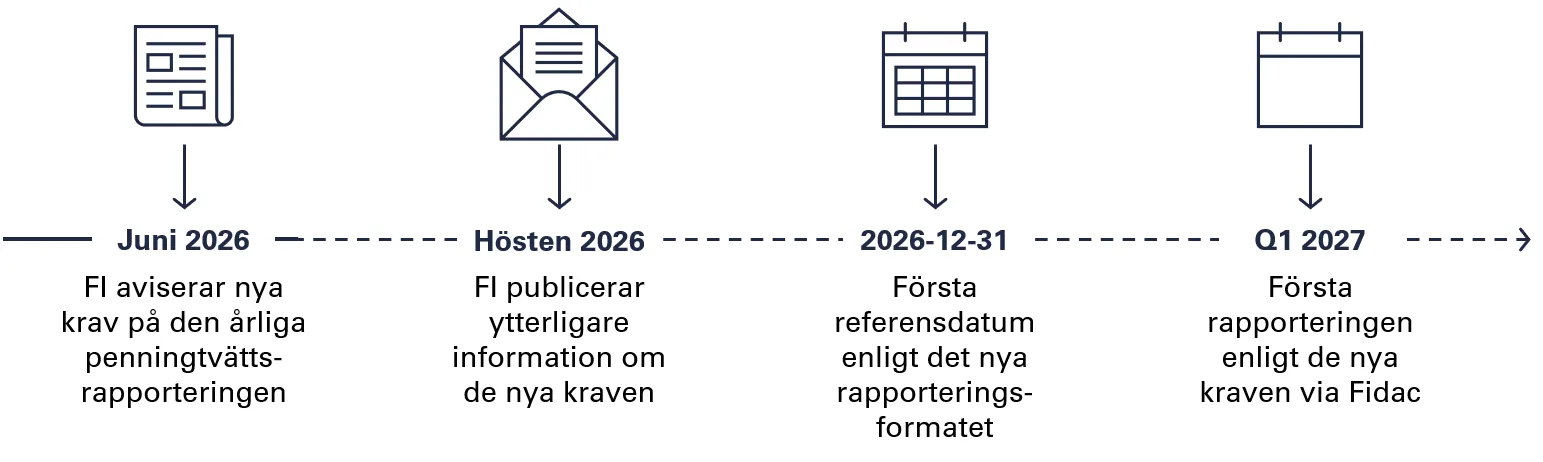
In June 2026, the Swedish Financial Supervisory Authority (FI) announced that the annual anti-money laundering reporting is undergoing significant changes. The changes are a direct consequence of the new EU-wide regulatory framework, under which the European Banking Authority (EBA), together with the European Anti-Money Laundering Authority (AMLA), has developed a harmonised methodology for risk classification. The new reporting requirements are based primarily on the annexes to two Regulatory Technical Standards (RTS) that establish, respectively, the methodology for assessing institutions' inherent and residual risk profiles as well as the criteria for selecting institutions to be placed under AMLA’s direct supervision.
The new data points to be reported are divided primarily into two main areas: firms’ inherent risks and the quality of their AML/CFT controls. With regard to inherent risk, more detailed information will be required going forward, including information on institutions’ customers, products and services, transaction and lending volumes as well as other relevant measures associated with each individual service. As regards the quality of AML/CFT controls, more detailed questions will be introduced concerning, for instance, monitoring systems (particularly automated systems), the distribution of customers across different risk categories, information on the most recent independent review or audit of AML/CFT procedures, and the extent to which key obligations have been outsourced to third-party service providers.
The regular reporting window will remain unchanged, running from 1 January to 31 March. This means that the first reporting under the new format will take place in Q1 2027, with a reference date of 31 December 2026. As the technical details and national adaptations have not yet been finalised, FI has announced that further information on the changes will be published in autumn 2026. All obliged entities will continue to submit their reports via Fidac, with those that qualify for direct supervision by AMLA required to report in accordance with the EBA taxonomy.
📝 Suspicious Transaction and Activity Reporting (STR/SAR)
The templates for ongoing reporting of suspicious transactions (Suspicious Transaction Report; STR) and suspicious activities (Suspicious Activity Report; SAR) are also set to undergo significant changes. Historically, differences between EU Member States’ national reporting templates have hindered both the exchange of information between the countries’ Financial Intelligence Units (FIUs) and the reporting process for cross-border entities.
To establish a common standard, AMLA has published a draft of Implementing Technical Standards (ITS). Among other things, the proposal would tailor reporting requirements more clearly to the type of obliged entity submitting the report, while also introducing more detailed and standardised requirements for both the suspicion reports themselves and the provision of transaction records.
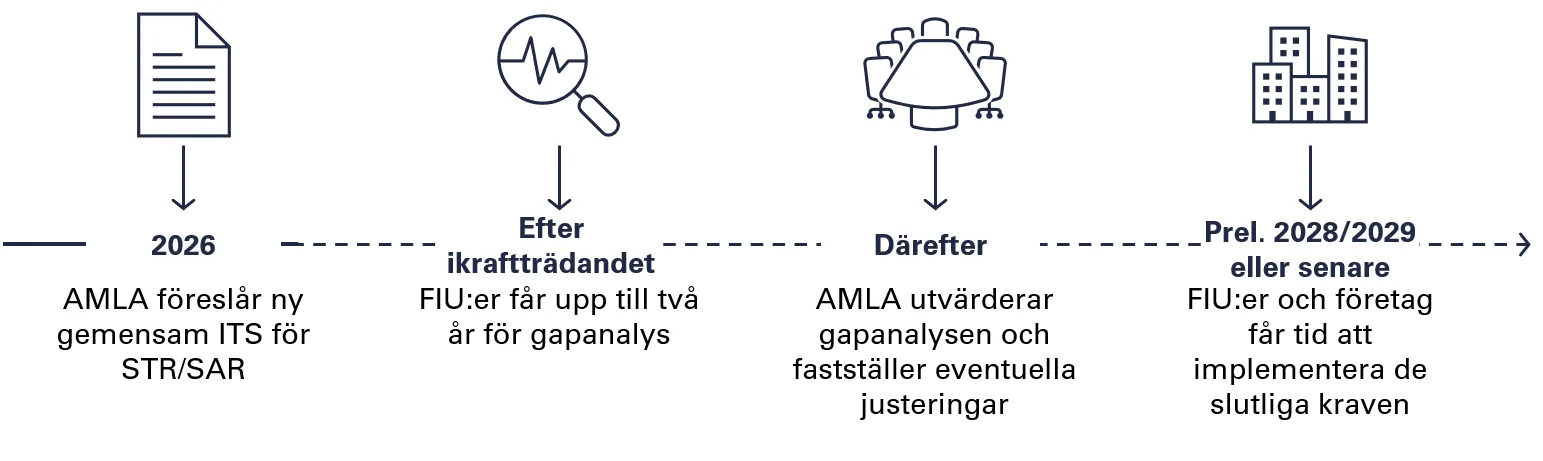
As the draft ITS is still under consultation and has not yet been formally adopted, the final implementation timeline has not yet been fully determined. According to the draft’s adaptation period (Article 10), implementation will take place in stages:
- First, FIUs (in Sweden, Finanspolisen) will have up to two years from the date the ITS enters into force to conduct a completeness assessment and gap analysis against their existing reporting and analysis platforms.
- The General Board of AMLA will then assess the results and decide on any adjustments or additions to the data points included in the templates.
- After this stage, FIUs and obliged entities will be given additional time to implement the established requirements in their internal systems and reporting interfaces.
This means that the changes to STR/SAR have a significantly longer time horizon than the changes to annual reporting and are, in practice, still a couple of years away.
💡 Next Steps
The introduction of the new and updated reporting requirements means that financial institutions and other obliged entities supervised by FI need to review their reporting solutions. This applies both to annual reporting to FI via Fidac and, at a later stage, to the reporting of suspicions to Finanspolisen via goAML.
For firms that currently report manually using the respective authorities’ web forms, the changes are likely to result primarily in increased administrative work to compile and enter the new information. For entities that use internal systems or automated integration solutions to generate, validate and submit their reports, however, the changes will require adaptations to data models and reporting workflows. As reporting requirements become more extensive, there is also likely to be a stronger incentive for more entities to move away from manual processes and instead implement structured and automated reporting solutions.
Whether your organisation needs support in analysing the new requirements, adapting existing internal reporting solutions or setting up a new automated reporting system, NFC can assist you in ensuring efficient and accurate reporting. Read more about our regulatory reporting services or contact us if you have any questions about the upcoming reporting requirements or need assistance implementing the new templates.